
Let’s start by looking at the graph. What do you see?

I know, I know. On the left, it’s Islam Makhachev vs. Jack Della Maddalena, and on the right, it’s Merab Dvalishvili vs. Petr Yan. To be more specific, it’s their third fight.
But what’s the point of putting these two fights together with a bunch of mathematical graphs?
If you watch both fights on tape, the difference is pretty clear.
Merab repeatedly struggled to drag the fight to the ground. Meanwhile, Islam Makhachev secured only four takedowns, yet managed to keep JDM underneath him for much of the fight.
“Does that mean Merab’s wrestling is bad and Islam’s wrestling is good?”
In reality, different opponents present very different problems to deal with. Yet we often compare fighters using mathematical concepts and numbers, something like the transitive property, or simply looking at who landed more on the stats sheet.
Keep in mind that in sports, especially combat sports, tactics and skills cannot be fully expressed through numbers. Fighters don’t apply exactly the same strategies and tools in every fight. That’s why MMA math is a misleading content. Seriously, I don’t know how many mathematical theorems fans have invented just to compare fights and fighters. Maybe someone is even working on Pythagoras right now.
Whether a fighter performs a beautiful judo throw or just a simple boring trip, on the stats sheet, both count as one successful takedown. We don’t know what position the fighters landed in, what grips were established, or how the opponent attempted to escape.
So when it comes to wrestling, the question is how a fighter drags his opponent into deep water, and more importantly, how long he can keep him there.
The Number That Hides the Problem

From the stats, if you stop and count the successful takedowns throughout the entire fight, there were only 5 in total. Now count the attempts: 58.
Impressive? If we’re talking about that relentless cardio tank, then yes. Merab broke the record for the huge amount of takedown attempt in one fight, tell me if it’s not an impressive.
But here’s the problem underneath: someone who only looks at the stats will probably come to the conclusion that Merab’s wrestling didn’t work in this fight.
He did land the takedowns, didn’t he? Five times. So at least part of his wrestling worked.
What’s worth paying more attention to is what he did after successfully dragging Yan to the ground.
Also, notice something else from the graph above? Despite those 58 takedown attempts, Merab accumulated only 1:54 of recorded control throughout the fight, with most of it coming from the first two rounds.
If we calculate only those first two rounds, where all five takedowns were successfully landed, we get approximately 19 seconds of recorded control per completed takedown.
Of course, control time also includes certain standing clinch positions, so this doesn’t mean every takedown produced exactly 19 seconds of ground control. But it gives us some idea of how little sustained control came from all that wrestling activity.
Throughout the first two rounds, as Merab changed levels and worked through his wrestling entries, he often ended up behind Yan with a rear body lock.
From there, Yan could use his arms to post against the mat, bring his legs underneath him, create separation between their hips and eventually recover his standing position.
Once Yan recovered his base and broke the connection, Merab had to work for another opportunity.
We see variations of this pattern throughout the opening rounds.
And when Yan started defending the initial entries more successfully, things became even more difficult. Merab went 0 for 39 in takedown attempts across the final three rounds. First part because of the cardio decrease, but the important part was Yan learned Merab’s entry pattern.
You’ve now seen a fight where an enormous number of takedown attempts struggled to produce sustained control. Now let’s move to a fight where takedowns occupied a relatively small part of the overall grappling process.
Four Takedowns That Controlled a Championship Fight

In contrast to Merab’s repeated takedown attempts, Islam Makhachev secured only four takedowns against Jack Della Maddalena, successfully completing all four of his recorded attempts.
And notice the difference in control time? 19:10 in total.
Do the math, and we have approximately 4:48 minutes of recorded control per completed takedown. Pretty dominant, isn’t it?
But behind that dominant grappling performance, there’s a different story.
Islam often worked quickly through the takedown phase, using leg attacks and trips to bring Jack to the ground. He generally needed fewer prolonged wrestling exchanges to complete his takedowns.
Another important difference was where the two fighters ended up after reaching the mat.
Islam and Jack frequently fought from half guard, while Merab often found himself controlling Yan from behind as Yan worked toward standing.
But there was actually a moment in Islam vs. Jack that gave us a similar position to the ones we saw in Merab vs. Yan 3.
At around the 2:30 mark of the first round, Jack moved out of half guard and, while scrambling his way toward standing, ended up in turtle position.
For those unfamiliar with the position, turtle is where the bottom fighter turns onto his knees and arms, generally protecting his front while exposing his back to the opponent.

From the pic, as Jack stepped forward with his left leg and attempted to move toward the fence, Islam inserted his right hook inside.
With the seatbelt grip connecting their upper bodies, Islam followed Jack’s movement and eventually secured his back.
That right hook was important because it gave Islam an additional point of connection to the lower body. If Jack continued moving, Islam had another way to follow him rather than relying entirely on his upper-body grip.
Compare that with some of Merab’s exchanges against Yan, where he attempted to land punches from behind while Yan was working to recover his base.
The problem with releasing a controlling grip to strike is that you’re temporarily giving your opponent milliseconds opportunity to move. If the rest of your position isn’t secure enough to compensate for that, the opponent can escape.
But like I said earlier, the difference in takedown attempts and positional control also varies depending on the opponent.
Throughout the fight against Jack Della Maddalena, Islam Makhachev repeatedly returned to a familiar position: top half guard.
From there, he could apply pressure, restrict movement and interrupt Jack’s escape attempts without constantly having to establish new positions.
A lot of Jack’s defensive work involved trying to create enough space to turn onto his side, establish an underhook or work toward an octopus-guard escape.
The difficulty was that Islam could respond before those movements developed into a meaningful scramble. When Jack attempted to improve his position, Islam adjusted his pressure and frequently restored control.
This is one of the reasons why we see relatively few open scrambles throughout the fight, despite spending so much time on the ground.
But what happens when the opponent refuses to let Islam settle into that position?
A Different Opponent Makes Control Harder
Let’s move to a fight where the same Islam Makhachev also found success with his takedowns but struggled more with retaining positional control.
At UFC 284, Islam completed four takedowns against Alexander Volkanovski over nine attempts.

Yes, just looking at the numbers, you already see the difference: this time, he recorded just 7:37 minutes of control in total.
To understand why, we need to look at how Volkanovski responded immediately after being taken down.
For this fight, let’s shift our focus to rounds two and three.
Why? Because, as you can see from the graph, rounds one and four were where Islam accumulated most of his control time. Those were the rounds where he managed to establish more sustained grappling positions.
In rounds two and three, however, Volkanovski was more successful at recovering his position and getting out of Islam’s control. Eventually control him back.
Anyway, let’s start. At around the 3:13 mark of round two, you’ll see a wrestling exchange where Islam secured a rear body lock on Volk. He then used a trip from that position, bringing Volk to the ground.
From there, Volk used his left arm and right leg to create a base, turning his body as he attempted to recover his position. With this movement, Volk created separation between their hips and eventually managed to stand up.

In round three, at around the 2:16 mark, we can see Islam securing a rear body lock again.
Volk stood up, but Islam had his right hook inserted, meaning Volk couldn’t freely separate.
With Islam maintaining his seatbelt grip, Volk worked to break the connection and create enough space to bring his arms inside. By establishing inside control, Volkanovski could turn to face Islam, escape the rear position and eventually press him back toward the fence.
Now, remember that sequence involving Jack Della Maddalena in round one?
Islam was able to follow Jack’s movement by combining upper-body control with the hook on the lower body.
Against Volkanovski, establishing that connection was only part of the problem. Volk actively worked to dismantle it by fighting the grips, recovering his base and turning to face Islam.
Once Volk managed to turn around, the original back-control opportunity was gone.
But Islam eventually found a solution in round four:
After another successful takedown, he secured Volkanovski’s back and locked in a body triangle, using his legs to maintain a much stronger connection around Volk’s torso.
This time, Volk spent much of the remaining round defending from that position. He successfully defended the submission threats, but separating from Islam became a much more difficult task.
Interestingly, Islam recorded 3:25 of control in that round alone, accounting for nearly half of his entire control time in the fight.
So, even against the same wrestler, four successful takedowns can lead to two very different outcomes.
Against Jack, Islam could repeatedly settle into half guard and interrupt his opponent’s escape attempts. Against Volk, establishing and maintaining those controlling connections required considerably more work.
But there’s another interesting situation in grappling.
What happens when the opponent successfully escapes a dominant position, yet somehow remains under the control of the same wrestler?
How Control Survives Even When a Position Is Lost

For this one, let’s move to UFC 319, where Khamzat Chimaev fought Dricus Du Plessis for the middleweight championship.
Khamzat successfully completed 12 out of 17 takedowns, with a total recorded control time of 21:40. That’s more takedowns and even more control than Islam against JDM.
But the interesting part here is how Khamzat maintained that control.
Early in the first round, Khamzat brought DDP to the ground and eventually secured the crucifix position. Throughout the fight, he repeatedly returned to this position.
For those unfamiliar with the crucifix, it allows the top player to restrict both of his opponent’s arms, leaving very limited options for defending strikes or creating space to escape.
Pretty uncomfortable position to be in, especially when the guy on top is Khamzat Chimaev.
But DDP wasn’t completely helpless from there. There was a moment he actual managed to escape the crucifix during the fight.
Round three gives us a particularly interesting example. DDP worked his way out of the crucifix, only for Khamzat to briefly establish mount before moving toward back control.
So technically, DDP successfully escaped a dominant position.
His problem? He was still underneath Khamzat during the transition and hadn’t recovered the freedom necessary to return to standing.
This is where the quality of Khamzat’s positional control becomes interesting.
As DDP escaped one position, his movement opened opportunities for Khamzat to establish another. Instead of spending all his effort trying to hold on to the crucifix, Khamzat could follow the movement and change the position he was using to control his opponent.
That also explains why being able to escape an individual grappling technique doesn’t necessarily mean you’ve escaped the entire grappling exchange.
Think about the difference between this fight and Islam vs. JDM.
Against Jack, we frequently saw Islam stabilizing half guard and preventing escape attempts from developing into larger scrambles.
Against DDP, we saw Khamzat maintaining control even when his opponent managed to escape a particular hold.
Both approaches allowed the wrestler to maintain an advantage without having to completely restart the wrestling exchange.
Of course, neither approach worked perfectly every single time. DDP eventually found some successful reversals in the final round.
But for most of the fight, whenever DDP solved one positional problem, he found himself dealing with another, that’s how important positional transition inside MMA. Not just fixed position or relentless takedown.
Why Landing a Takedown Sometimes Produces So Little
Now let’s go back to Merab Dvalishvili and Petr Yan. Remember how Yan repeatedly recovered his base after being taken down?
After looking at Islam and Khamzat, the problem becomes a little clearer.
When a fighter completes a takedown but hasn’t established sufficient control over his opponent’s movement, the opponent still has opportunities to post, rotate his hips, recover his legs or turn toward the wrestler.
Every time Yan successfully broke that connection, Merab lost the positional advantage he had worked to create.
And what did Merab have to do afterward? Separate and attempt another takedown.
We can also find a similar situation in the fight between Ciryl Gane and Josh Hokit at UFC 334.
Early in round three, Hokit successfully brought Gane down, but Gane quickly recovered his feet. Although Hokit continued finding opportunities to attack from close range, repeatedly forward pressure, the completed takedown didn’t develop into prolonged ground control.
We saw another quick recovery from Gane in the final round.
Of course, these exchanges don’t mean Hokit’s wrestling produced nothing. His pressure and ability to force close-range exchanges remained important parts of his performance.
The same applies to Merab. His wrestling pressure has been extremely effective throughout his career, even when he hasn’t accumulated much ground control.
But if the specific goal is to keep the opponent on the ground, then completing a takedown without establishing sufficient positional control leaves a significant part of the job unfinished.
And this is also why comparing wrestlers through takedown attempts alone can give us such a misleading picture. Even in wrestling competitions, the important point is you have to pin the opponent on the ground in a short amount of time before you can be resulted as victory.
Wrestling Volume vs. Wrestling Effectiveness
Let’s return to the two graphs we looked at at the beginning of the article:
- Fifty-eight takedown attempts from Merab Dvalishvili, producing 1:54 of recorded control.
- Four takedowns from Islam Makhachev, producing 19:10.
The difference comes from several stages of the grappling exchange.
First, the wrestler needs to successfully bring the opponent to the ground. Then he needs to establish a position that restricts the opponent’s movement. And whenever the opponent attempts to escape, the wrestler needs to either maintain that position or transition to another one without surrendering the overall advantage.
Against JDM, Islam was able to repeatedly establish and stabilize his half guard control. Against Volkanovski, the same wrestler encountered an opponent who was more successful at disrupting those controlling connections.
Meanwhile, Khamzat demonstrated how positional control could survive even when the opponent escaped an individual hold.
And in the fights involving Merab and Hokit, we saw how effective defensive grappling could prevent successful takedowns from turning into sustained control.
So, is a wrestler who attempts 58 takedowns necessarily worse than one who attempts only four?
Not necessarily. The opponent, the positions available and the purpose behind those wrestling attempts all matter. It was never a linear approach for every fighters and fights.
But if we’re specifically comparing the ability to establish and maintain ground control, the difference between these performances is enormous.
One wrestler repeatedly had to fight for another opportunity to bring his opponent down. Another could spend several minutes working from the advantage he had already created.
And that’s a part of MMA wrestling that a simple takedown count will never fully explain.
Discover more from Data Combat Sport
Subscribe to get the latest posts sent to your email.
Related posts:


Related Posts

How to Escape Submissions Systematically: John Danaher’s Reverse-Engineering Approach
Why Memorized Submission Escapes Fail? 📝 You enter a BJJ…
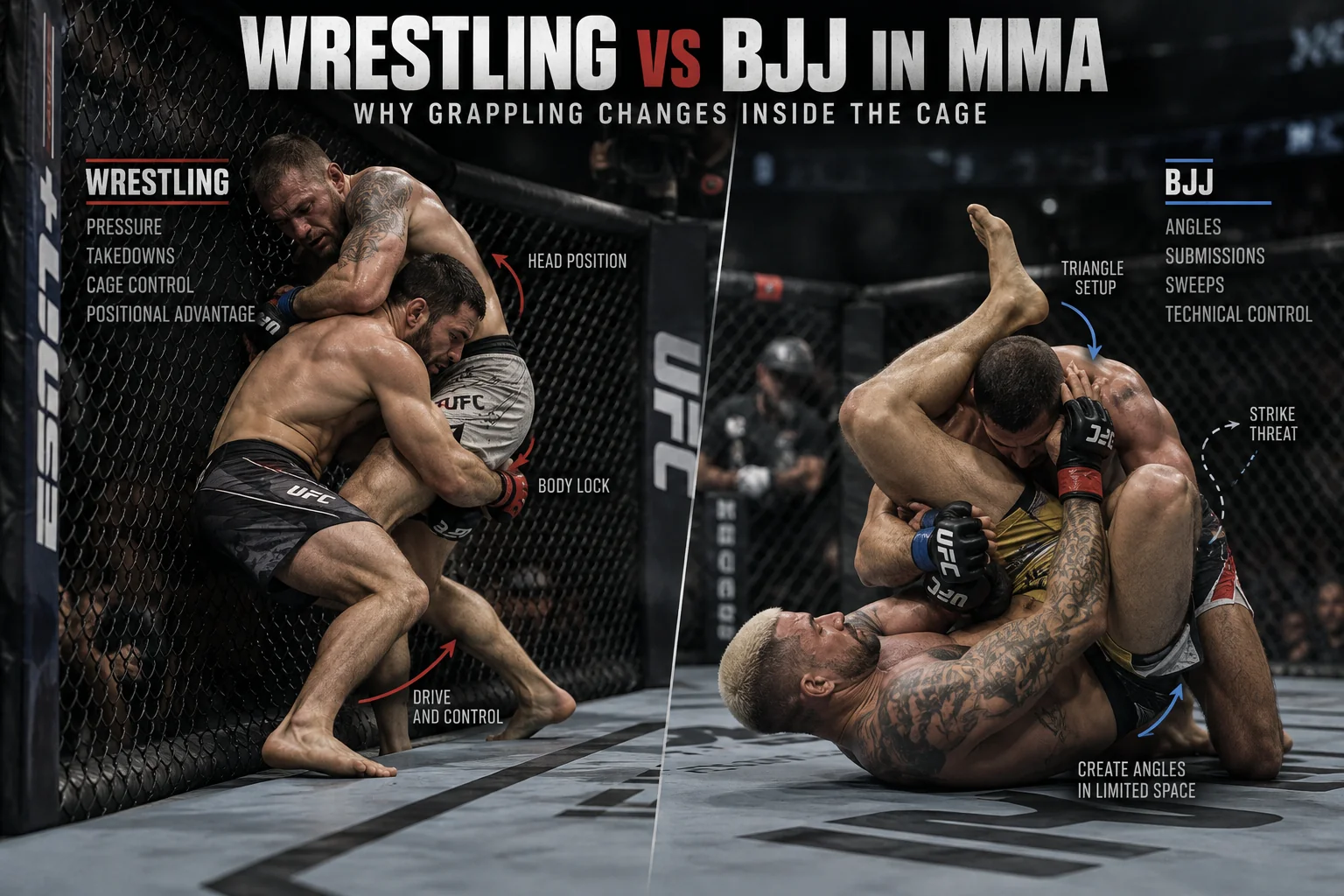
Wrestling vs BJJ in MMA: Why Grappling Changes Inside the Cage
Why Can't He Just Stand Up? 😤 You've seen it…

Understand Why a BJJ Black Belt Doesn’t Guarantee Dominance in MMA
When a fight hits the ground in MMA, one assumption…